.svg)
The traditional employee benefits renewal cycle is fundamentally broken. Driven by compounding rate spikes and the functional death of "no-shop" renewals, benefits brokerages are losing an average of eight or more hours of high-value labor per employer group to manual spreadsheets and data entry. In a recent live webinar, Plansight CMO Adam Smith, Senior Advisor Scott Millson, and Founder and Chief Product Officer Steve Overton unpacked this "black hole" in quoting. They revealed how shifting from fragmented legacy workflows to an automated, end-to-end RFP ecosystem dramatically reduces administrative overhead, eliminates errors, and empowers brokers to pivot from data processors to strategic consultants.
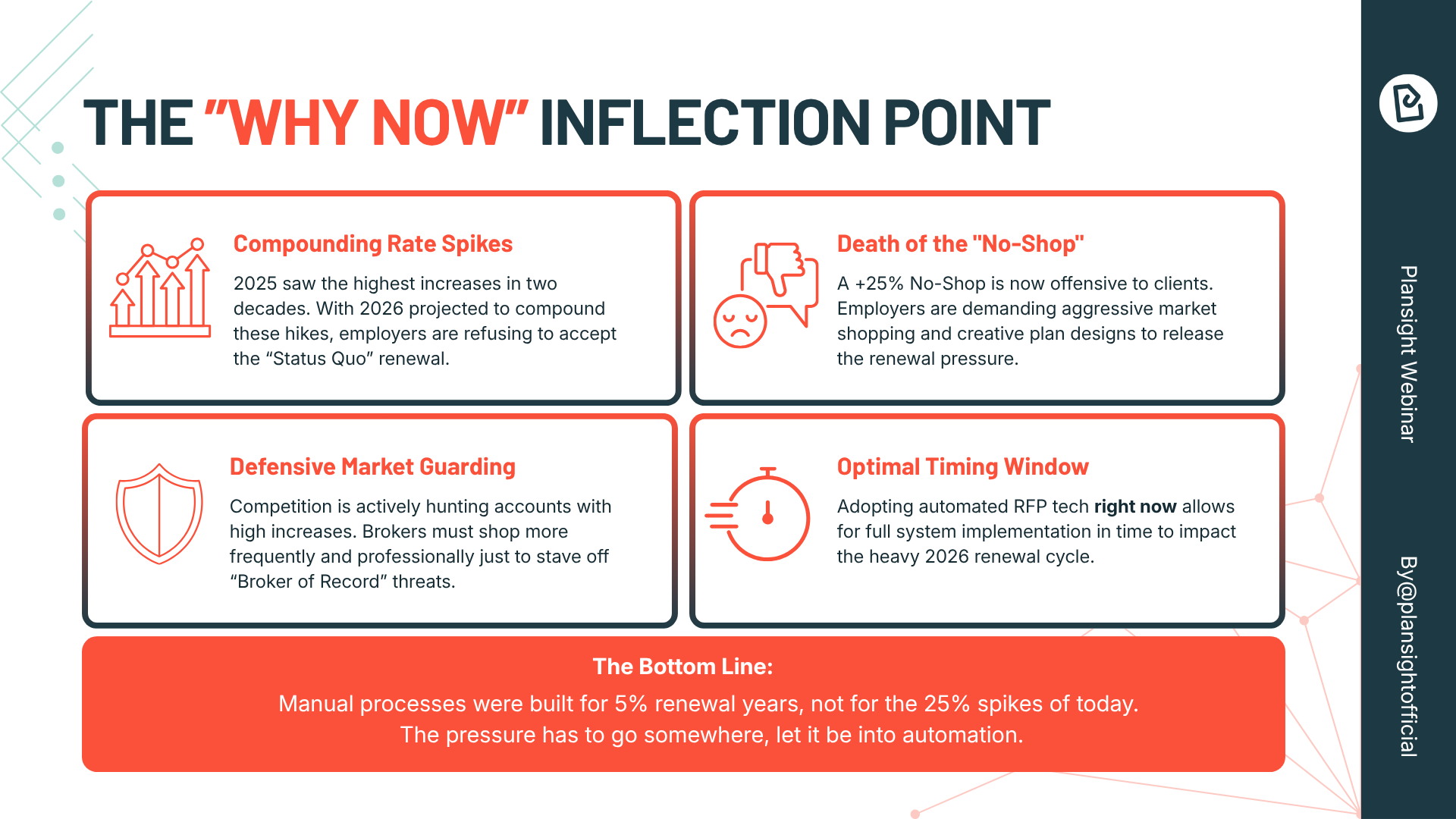
For decades, benefits agencies built operational models around single-digit renewal years. When a carrier delivered a digestible 4% to 6% premium increase, account teams frequently relied on "no-shop" renewals to stay afloat during the intense fourth-quarter crunch.
Those days are officially over.
Data from Mercer and the Bureau of Labor Statistics show that health benefit costs continue to outpace general inflation, reaching historic multi-decade highs. Concurrently, research from Lockton underscores a massive macroeconomic flip-flop: for the first time, employers cite reducing costs as their absolute highest priority when designing a benefits package, far eclipsing talent attraction and retention.
“You can't no shop a twenty percent rate increase,” warned Scott. “You're gonna get fired on the spot if you take it to your customer and say, Hey, we got a twenty percent no shop. We're gonna go ahead and take that. You will be taking that out to market.”
This reality creates an urgent inflection point. Brokers face an unprecedented volume of RFPs because client demand has killed the no-shop renewal. Agencies using manual operational processes are watching their profit margins erode under the sheer weight of administrative work. To remain competitive, modern agencies must proactively transition from data entry to strategy before the peak fourth-quarter crunch hits.
When analyzing where time goes during a traditional marketing cycle, account managers and producers are routinely swallowed by a highly fragmented administrative process. Scott shared a striking parallel to explain this operational gridlock: the universal remote.
Years ago, turning on a home entertainment system required a basket full of different remotes: one for the TV, one for the amplifier, one for the DVD player, and another for the cable box. It was exhausting and unnecessarily complex. Yet, benefits brokerages still operate this way every day, executing what Plansight terms the "5-system shuffle".
Account teams must manually pull census data from an HR platform, track down old plan booklets, log into half a dozen disparate carrier portals, copy and paste quote details into a master Excel file, and manually format an agency presentation from scratch.
The consequences of this manual burden include:
To break this cycle, agencies need a modern operational approach. Forward-thinking groups are learning how to bet on yourself by leaving clunky manual data aggregation behind.
The math behind legacy workflows paints a bleak picture for agency efficiency. According to data verified by Plansight users, a completely manual process requires an average of 10.5 hours of labor per RFP.
Cost Comparison: Time Spent Per RFP
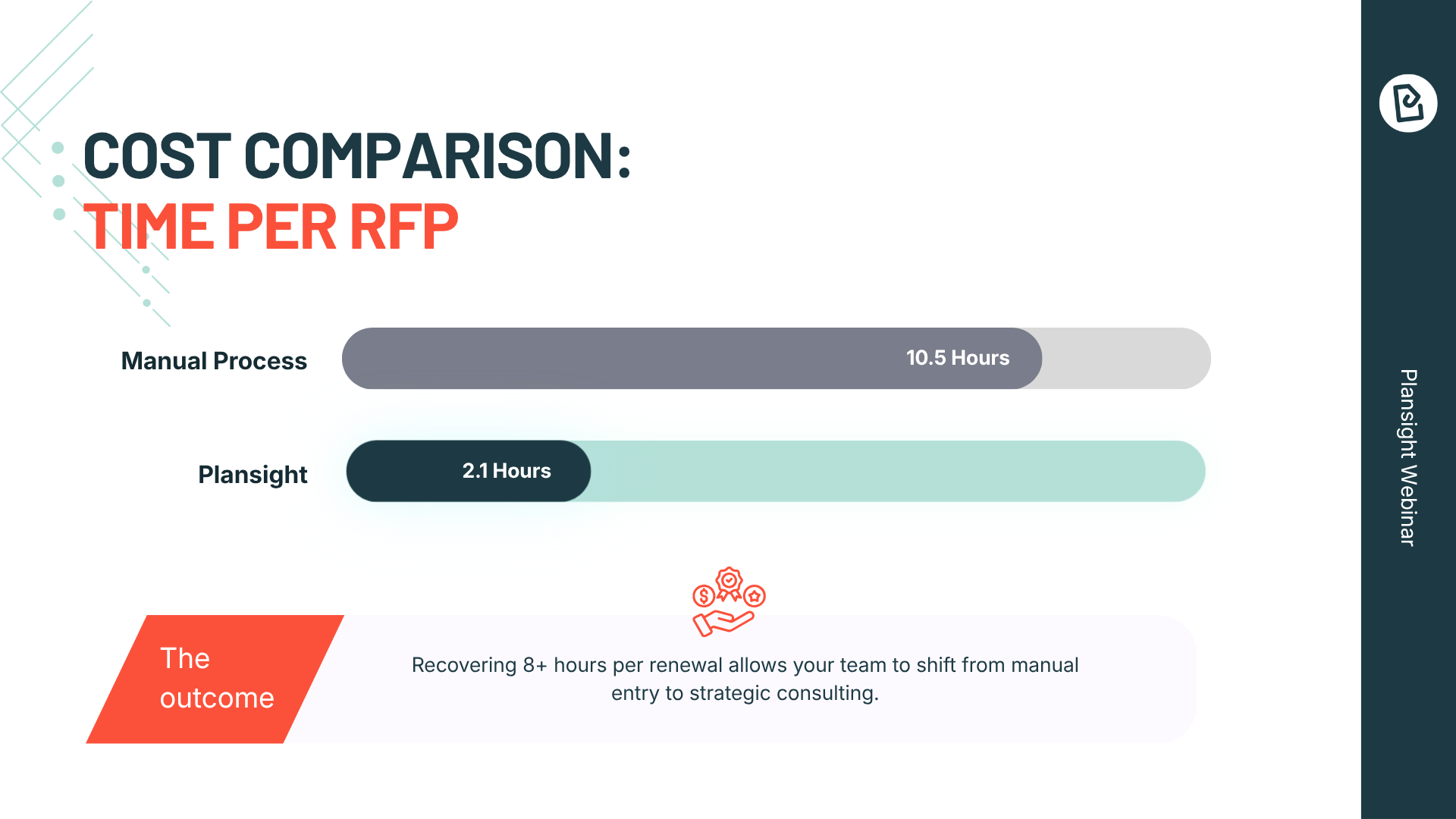
Even these conservative estimates assume an ideal scenario. When brokerages add up the time spent chasing carriers, reviewing spreadsheets across multiple pairs of eyes, and updating downstream agency management systems, the true labor tax is often significantly higher. This fragmentation pulls high-value account executives away from strategic consulting and traps them in the role of data-entry clerks. Agencies can no longer afford to ignore the innovation gap, as closing it directly protects agency profit margins.
To address this structural bottleneck, Plansight built a unified platform specifically for the employee benefits space. Rather than navigating a loose collection of standalone features, the platform uses artificial intelligence and guided, automated workflows to take a renewal full circle in a single system.
During the session, Steve demonstrated the live workflow by dropping raw dental, vision, and medical renewal documents directly into the platform. PlansightAI immediately read the files, mapped out current versus renewal plan designs, pulled the rates, and built an interactive pre-renewal summary.
Key pillars of this end-to-end ecosystem include:
Agencies can further bridge the gap by leveraging deep, two-way digital platform integrations with industry staples like BenefitPoint and Employee Navigator, pulling live census data and pushing enforced plan designs back into their systems without manual data re-entry. Embracing this shift moves brokerages away from reactive administrative work and shifts them beyond the renewal.
Unlocking more than eight hours of capacity per renewal group completely reshapes an agency's bottom line. However, as Adam noted during the webinar, technology's ultimate return on investment is determined entirely by what you do with the time you reclaim.
“When we save time on the tedious, mundane tasks,” Adam stated, “we can repurpose that time to focus on the core values and the actual value add that the agency has.”
A poll taken during the live session showed that 70% of attendees want to invest their recovered hours into "all of the above"-combining new business generation, enhanced client retention, and personal time.
By modernizing operations, account teams can move away from time-consuming administrative work and dive into high-value consulting. Instead of dropping a massive static spreadsheet on an employer's desk, brokers can actively model alternative premium contributions and plan designs live during a renewal meeting. This high-tech transparency addresses the human advantage, reinforcing consumer trust precisely when cost pressures are highest.

The operational pressures of the current benefits market require a modern approach. Agencies cannot expect to scale while their teams are trapped in the daily friction of the 5-system shuffle. Transitioning to a structured, AI-driven digital workflow allows brokerages to protect their existing book of business, comfortably sell more ancillary coverage lines, and maximize high-value consultant output without adding headcount.
To see how these workflows look with your actual business files, learn more about our platform approach by checking out our comprehensive guide to production-ready AI.
If you haven’t seen Plansight in action and you want to, book a discovery call with us.
At the end of the day, Plansight is more than just an application. It is a partner built with brokerages and their benefits teams in mind. Plansight is the only AI application that manages your benefits renewal and marketing workflow. It brings transparency, consistency, and time savings to every group renewal.
From SmartSheetingAI™ to RFP automation to side-by-side comparisons to the intelligence of PlansightAI™, everything we create is designed to lighten the load, reduce risk, and elevate your client relationships. Your team is your greatest asset, and Plansight is here to make sure they have the tools, insights, and support to shine.
Plansight works alongside leading General Agencies to help brokers move faster, stay compliant, and deliver a better client experience. You can explore our trusted GA partners here.
For brokers, Plansight transforms a manual, time-consuming RFP workflow into one that is faster, more efficient, and more profitable, without sacrificing accuracy or control.