.svg)
Two benefit teams open in the same week, with the same stack of community-rated medical groups renewing at once. One team pulls the census into a spreadsheet, rebuilds last year’s comparison from scratch, keys in rates plan by plan, recalculates contributions every time the employer asks what a different buy-up would do, and then builds employee worksheets by hand for every group. The other team uploads the census and reviews what the application already built.
The gap between those two teams is measured in hours nobody bills for. Spreadsheeting a single proposal by hand takes 45 to 60 minutes, and a community-rated renewal is never a single proposal. It is the current plan, the renewal, and every alternative worth putting in front of the client. Multiply that by every carrier quoting, and the week is gone to data entry, before anyone has spent a minute on what to actually recommend.
Plansight Head of Marketing Cole Herman and Founder and Chief Product Officer Steve Overton ran a live webinar walking a community-rated small group from an empty record to elected plans in force. What follows is what the walkthrough showed, step by step, and what each step replaces.
Every community-rated renewal starts the same way: an empty record, a census file, and a stack of plans nobody has priced yet. Everything between that and a client-ready presentation is hand work, and none of it is the part a broker is paid for.
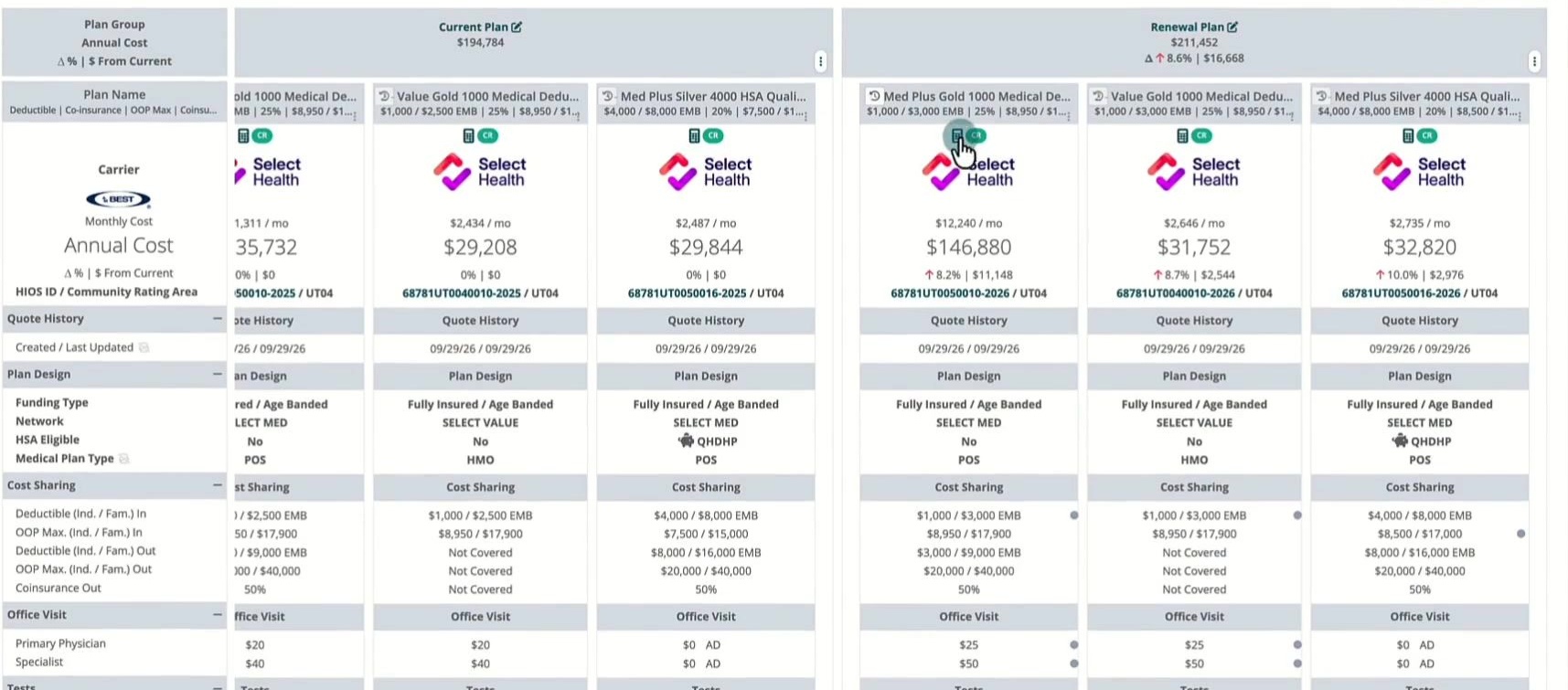
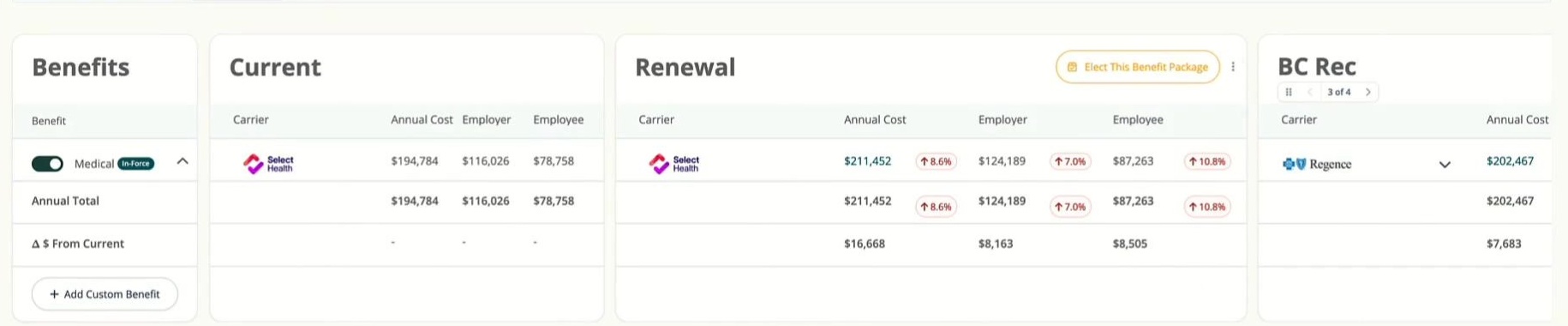
The live build started from a customer record with nothing in it. Three current plans added, a census dragged in, one click to calculate rates. The renewal came back at 8.6% over the current rate, an extra $16,668 a year, before anyone had opened a spreadsheet.
Getting there, the AI read and interpreted the census, flagged data errors, surfaced demographics, flagged an employee approaching Medicare eligibility at 66, and showed which employees are in states with statutory disability obligations. It then calculated the rates and produced the renewal summary, the market response page, and the spreadsheet, with every plan-design deviation marked: a copay moving from $20 to $25, a changed deductible, a changed out-of-pocket maximum.
The pressure behind this is not easing. Clients expect to see more alternatives, not fewer, now that rising health costs force more renewal scenarios, and each one meant another rebuild of the presentation.
The broker's first look at the renewal is a finished renewal, not a blank spreadsheet waiting to be filled.
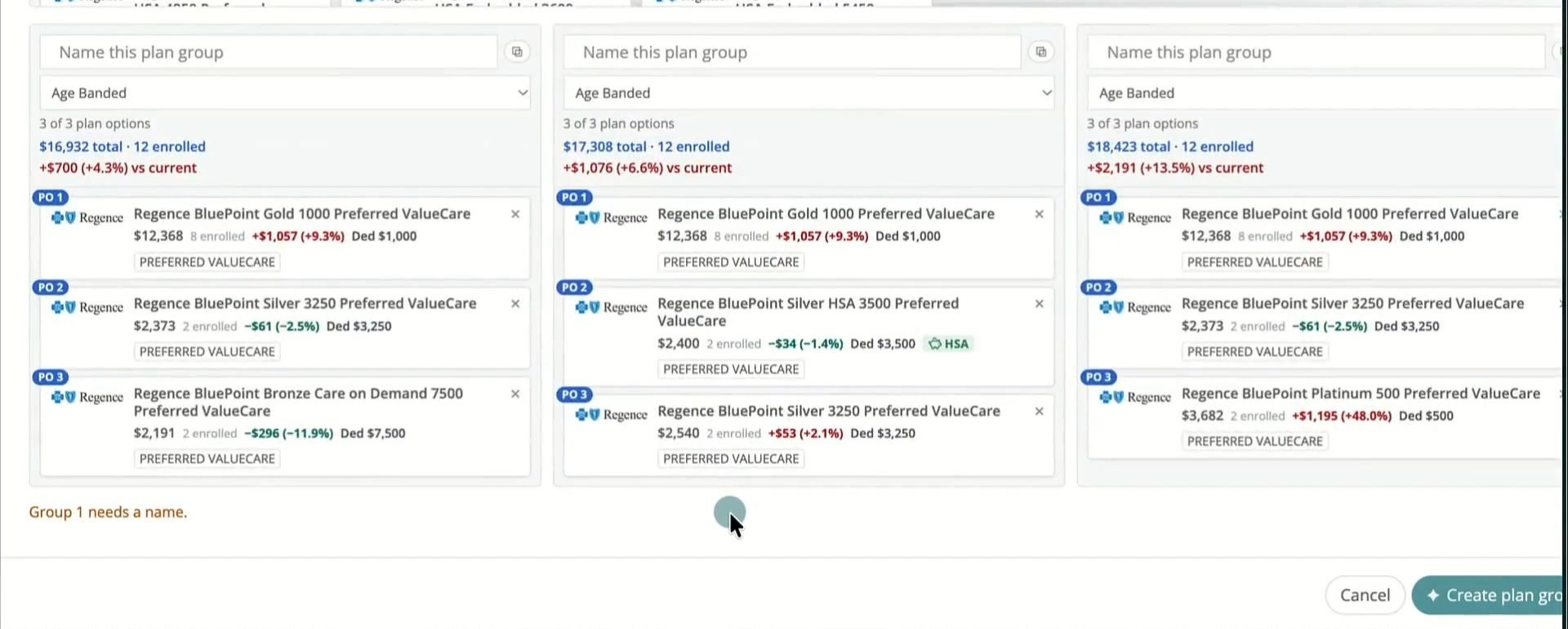
Community-rated shopping is not a single plan comparison. Groups offer dual and triple options, with specific people enrolled in each, so the honest question is never what a single plan costs. It is what a package costs for the eight people on option one, the two on option two, and the two on option three.
Doing that by hand means pricing every combination separately and hoping the arithmetic holds. The AI pulls alternatives from the rating engine, filters them by carrier and network, and builds plan groups: up to 20 options pulled in at once and up to 5 plan groups built at a time, each priced against the people actually enrolled. Swap one plan for another, and the package reprices immediately, so a buy-up running 48% over current gets dropped in seconds while a plan landing 2.5% under current stays. Three packages built from the same twelve lives came in at 4.3%, 6.6%, and 13.5% over current, and that spread is the decision.
The AI also prices every plan as if the entire population enrolled, which is the only way to see relative cost cleanly. A plan can look cheap simply because the younger employees landed on it. Clear every filter on one community-rated group, and the table runs to 121 plans, with monthly premiums ranging from $11,000 to $25,000. That spread is the case for filtering by carrier and network before building anything, and for pricing packages against real enrollment instead of a blended average.
Knowing the market is the broker’s job, and pricing every permutation of it is not.
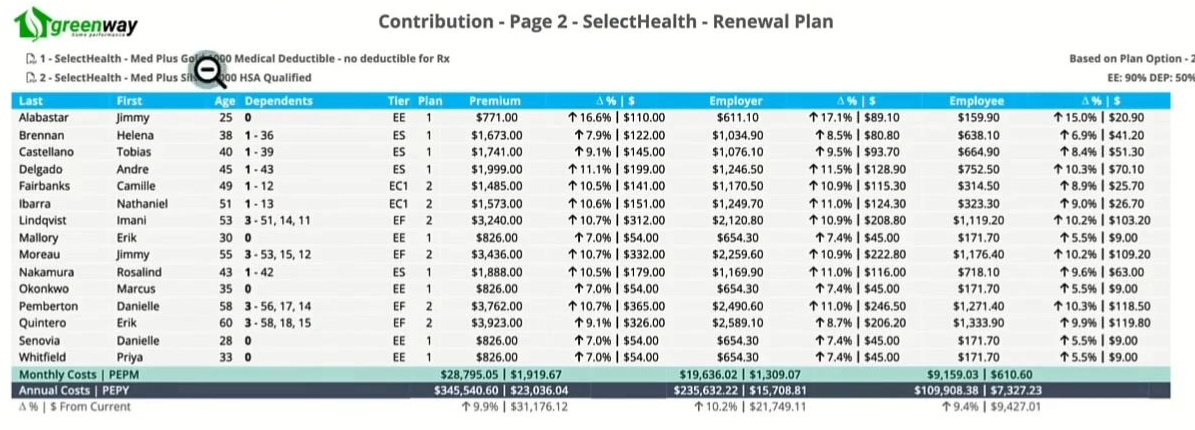
Age-banded community rating is where small group gets genuinely hard. When every employee has a different rate by age, a buy-up contribution strategy has to be proven on an employee-by-employee, dependent-by-dependent basis before anyone can defend it in an HR meeting.
The AI runs defined contribution, percentage, percentage by employee and dependent, and percentage by tier, and it models current and renewal separately so the client sees what is and what will be. Shift cost toward employees at renewal, and the AI rebuilds every affected page, including the member-level breakdown showing who costs what, what the employer pays, and which minor dependents are free under the group’s rules.
That is the difference between presenting a spreadsheet and holding a real conversation: the shift from static spreadsheets to live in-meeting modeling. When the client asks what happens if they move the base plan, the answer is on screen.
Contribution strategy stops being something you prepare and becomes something you model in the room.
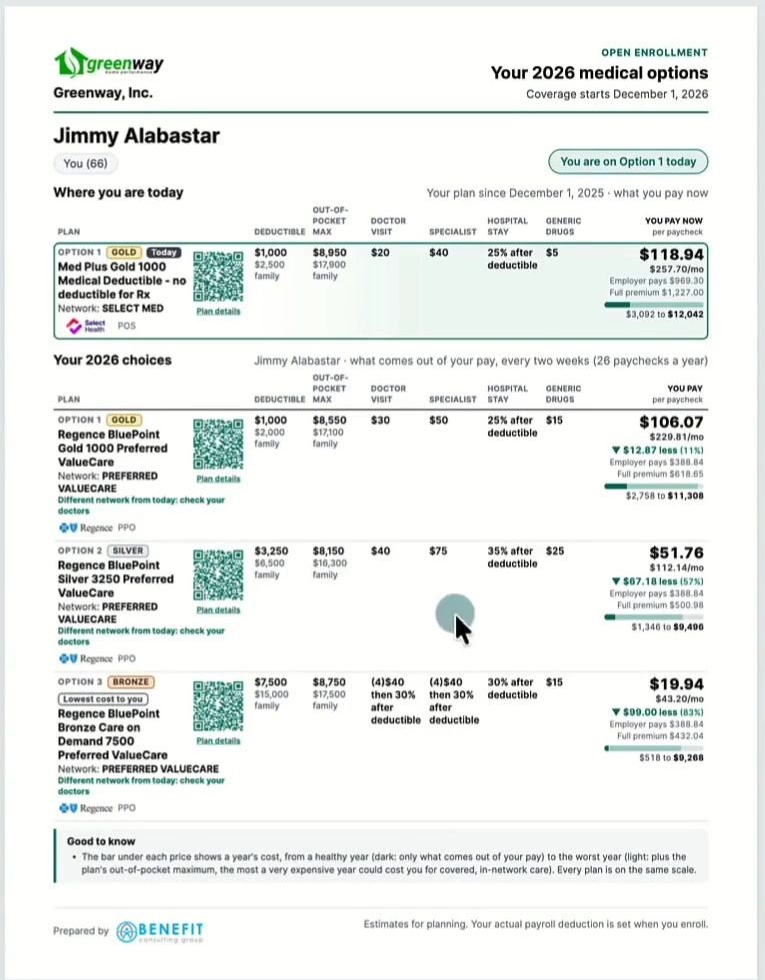
The pages an employer uses to decide are not the pages an employee needs. Most teams build the employer presentation, then rebuild the information again as handouts, per payroll cycle, per option.
The AI produces employee worksheets from whichever package the client elects. Each worksheet shows the employee where they are today, where they land next year, what it costs per pay period, what the employer covers, and worst-case out-of-pocket exposure, with HSA eligibility and lowest-cost options accounted for. QR codes open the summary of benefits and coverage directly from the printed page, and signature pages are optional. Agency branding, colors, and disclaimers are configurable.
The same principle drives the Brite integration that carries sold plan data into enrollment guides: data entered once should travel, not get retyped at every handoff.
The handout the employee takes home is generated from the same data the employer just approved, so the two never disagree.
A renewal is not finished when the client picks a plan. It is finished when the elected plans are in force, recorded, and reflected everywhere else they need to live.
Inside the Benefit Builder, the AI treats current, renewal, and every alternative as separate scenarios, each of which is printable. The broker elects the package, the AI marks it in force with the correct effective and renewal dates, produces a sold summary, and moves the prior plan year into history once the new coverage begins. What stays visible is what is active or about to be, which is how a chronological record of a group builds itself over years without anyone maintaining it. Plansight’s work on the Benefit Builder and election workflow and on ending double entry into BenefitPoint and Employee Navigator both come back to the same point.
Keying elected plans into two other systems is not documentation; it is duplicate work the AI should already have done.
Small group is where brokerages win relationships early and quietly lose margin. The accounts are too small to justify heroic effort and too numerous to ignore, so the work gets compressed into the weeks before the common effective date and absorbed by whoever is willing to stay late.
That tradeoff is a workflow problem, not a staffing problem. When the AI builds the renewal from the census, prices the packages against real enrollment, runs the contribution math at the member level, produces both the employer presentation and the employee worksheets, and files the election, what remains is the part a broker is actually paid for: knowing the market, reading the client, and making the recommendation.
PlansightAI™ is the only AI application that manages your benefits renewal and marketing workflow. For community-rated quoting, teams can be running groups the same day they gain access. One agency ran a batch of them before their first training session.
Your judgment is the scarce resource. Don't spend it on arithmetic.

Bring one real community-rated group to the call. We will build the current plan, add the renewal from your census, assemble a few alternatives into plan groups, set contributions, and print the presentation while you watch, so you can judge the workflow on your own data rather than a demo file.
If you haven’t seen Plansight in action and you want to, Book a Discovery Call with us.
At the end of the day, Plansight is more than just an application. It is a partner built with brokerages and their benefits teams in mind. Plansight is the only AI application that manages your benefits renewal and marketing workflow. It brings transparency, consistency, and time savings to every group renewal.
From SmartSheetingAI™ to RFP automation to side-by-side comparisons to the intelligence of PlansightAI™, everything we create is designed to lighten the load, reduce risk, and elevate your client relationships. Your team is your greatest asset, and Plansight is here to make sure they have the tools, insights, and support to shine.
Plansight works alongside leading General Agencies to help brokers move faster, stay compliant, and deliver a better client experience. You can explore our trusted GA partners here.
For brokers, Plansight transforms a manual, time-consuming RFP process into one that is faster, more efficient, and more profitable, without sacrificing accuracy or control.