.svg)
Every fall, some brokers watch a client react to a renewal number that landed cold, in a letter or an email, with no warning attached. Other brokers deliver the same number to a client who already knows it's coming, because a plan was already in motion.
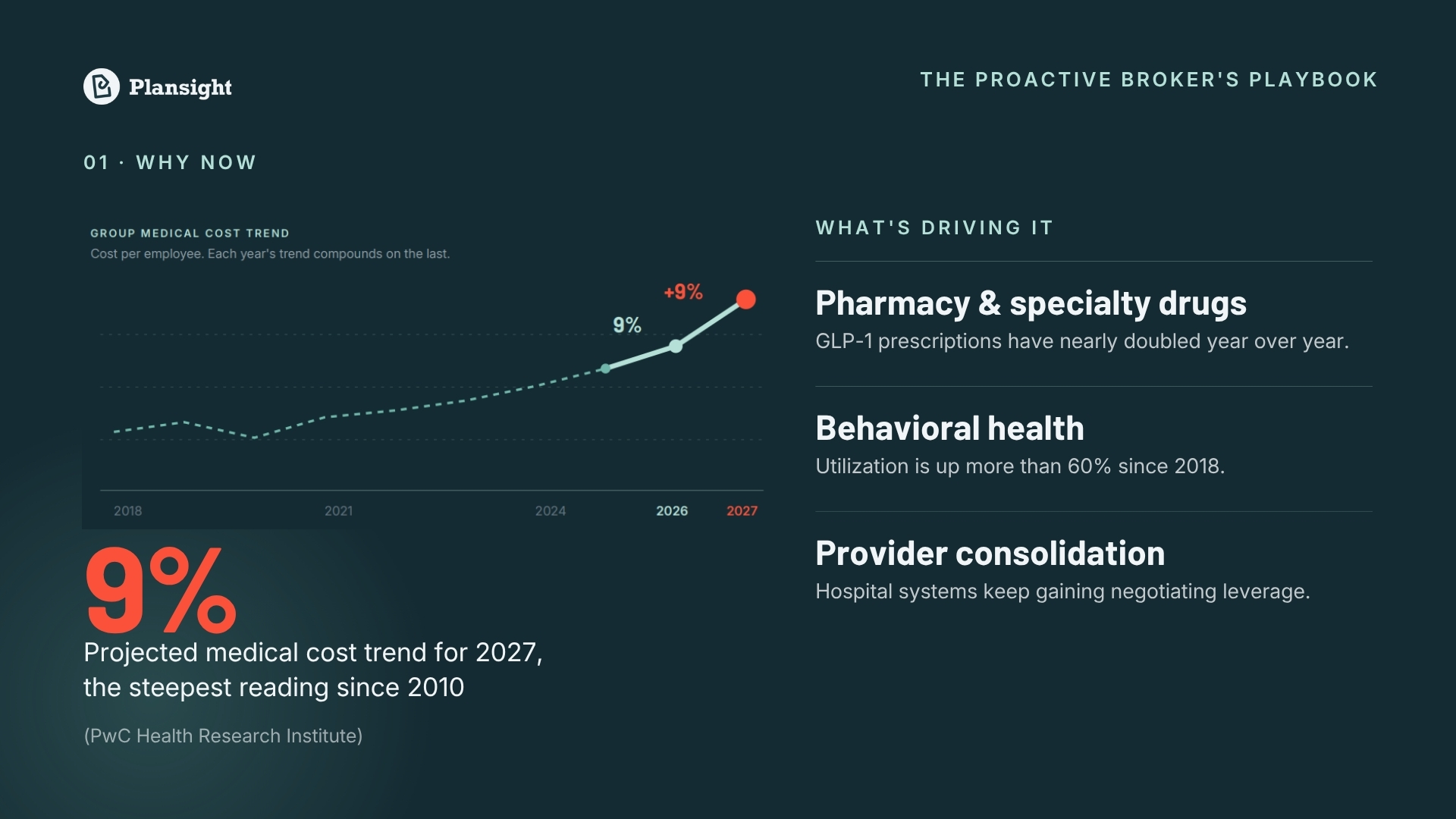
Heading into 2027, that number is worse than anything either firm has projected in seventeen years. Aon is calling for a 9.5% average increase, marking the first time average cost per employee crosses $19,000. PwC opened its 2026 projection at 8.5%, revised it up to 9% by year-end, and is now calling for another 9% for 2027.
Plansight CEO Weston Lunsford, Founder and Chief Product Officer Steve Overton, and Director of Demand Generation Cole Herman sat down for a live webinar to break down why most brokerages can only run a proactive renewal conversation for their ten largest accounts, and the exact three-step call structure that makes it possible to run for the whole book instead.
Two firms, two different methodologies, landing in the same place. As Weston put it on the call, "The average is the least useful number in the reports that are going out right now."
Aon's projection draws on data from 1,100 employers, 7.9 million lives, and $135 billion in claims. Within that average, the middle 50% of employers landed anywhere from 5.5% to 11.5%, a six-point spread hidden within a single headline figure.
That spread is the difference between a broker who reads the average out loud and one who can tell a client where their specific claims actually put them inside it, and why. One is reciting news. The other is advising.
Weston opened with a story from his own time running a company as an employer. His broker called him in the middle of August, months before renewal, to say he was taking a proactive approach to get ahead on the year's numbers. Lunsford still tells people about that call.
Steve, who spent decades as a working broker before founding Plansight, has lived the alternative too: "I've had times where my clients saw the renewal letter before I ever talked to them about it. That's a frightening situation." The reassuring version isn't complicated. A client needs to hear about the market shift before the letter arrives, with a plan already attached.
Most brokerages only run that call for their ten or twenty largest accounts, not because those clients matter more, but because a manual process runs out of hours somewhere around there.
Here's the part that actually keeps brokers from picking up the phone: the call itself takes eight to twelve minutes. That's not the hard part. The hard part is what it commits you to. The moment you tell a client you're on top of their renewal, you have to be.
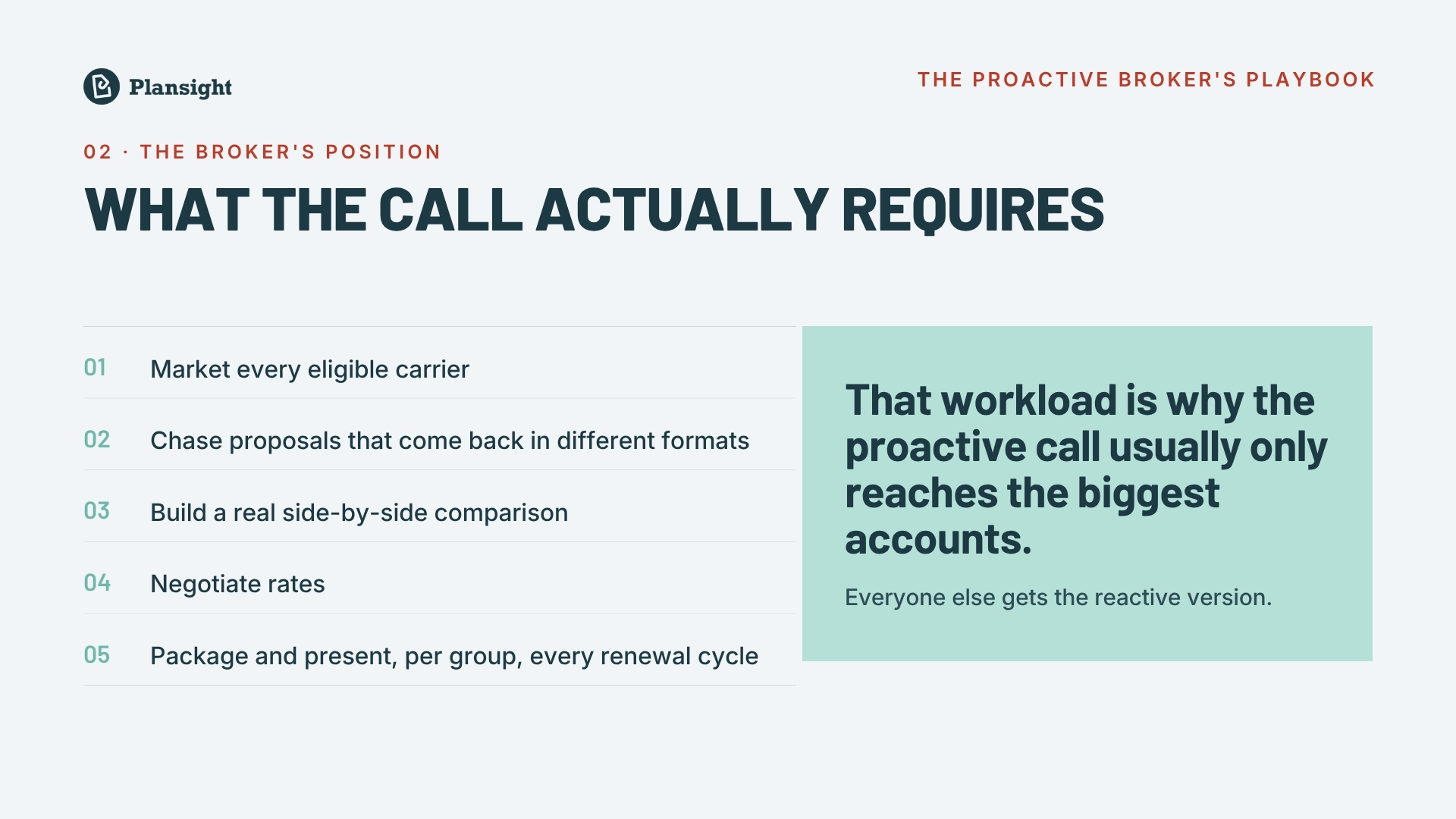
The structure Weston and Steve walked through breaks into three parts: frame, problem, promise. On the call, it plays out like this.
1. Case open (about twenty seconds). Name who you are and why you're calling, framed entirely around the client's team, not the policy: "I'm reaching out early on purpose. Our approach is to stay ahead of your benefits, so when renewal comes around, you're offering a strong, competitive package at the best possible price."
2. Needs audit. Name the problem and cite an external authority, such as Aon or PwC, so the broker isn't the one delivering bad news. Make it clear that the increase is market-wide, not specific to this client's plan. Then ask for thirty minutes, and close with a specific day and time on the calendar, not a vague "let's connect soon."
3. Solution presentation. This is the promise: market every carrier and funding strategy, build a real side-by-side instead of forwarding carrier marketing decks, negotiate rates down, and bring back a ranked set of options for the client to review and decide on together.
You don't need the renewal number in hand to make this call. Not having it yet is the point. It positions the broker as the one shaping the outcome rather than reacting to it later.
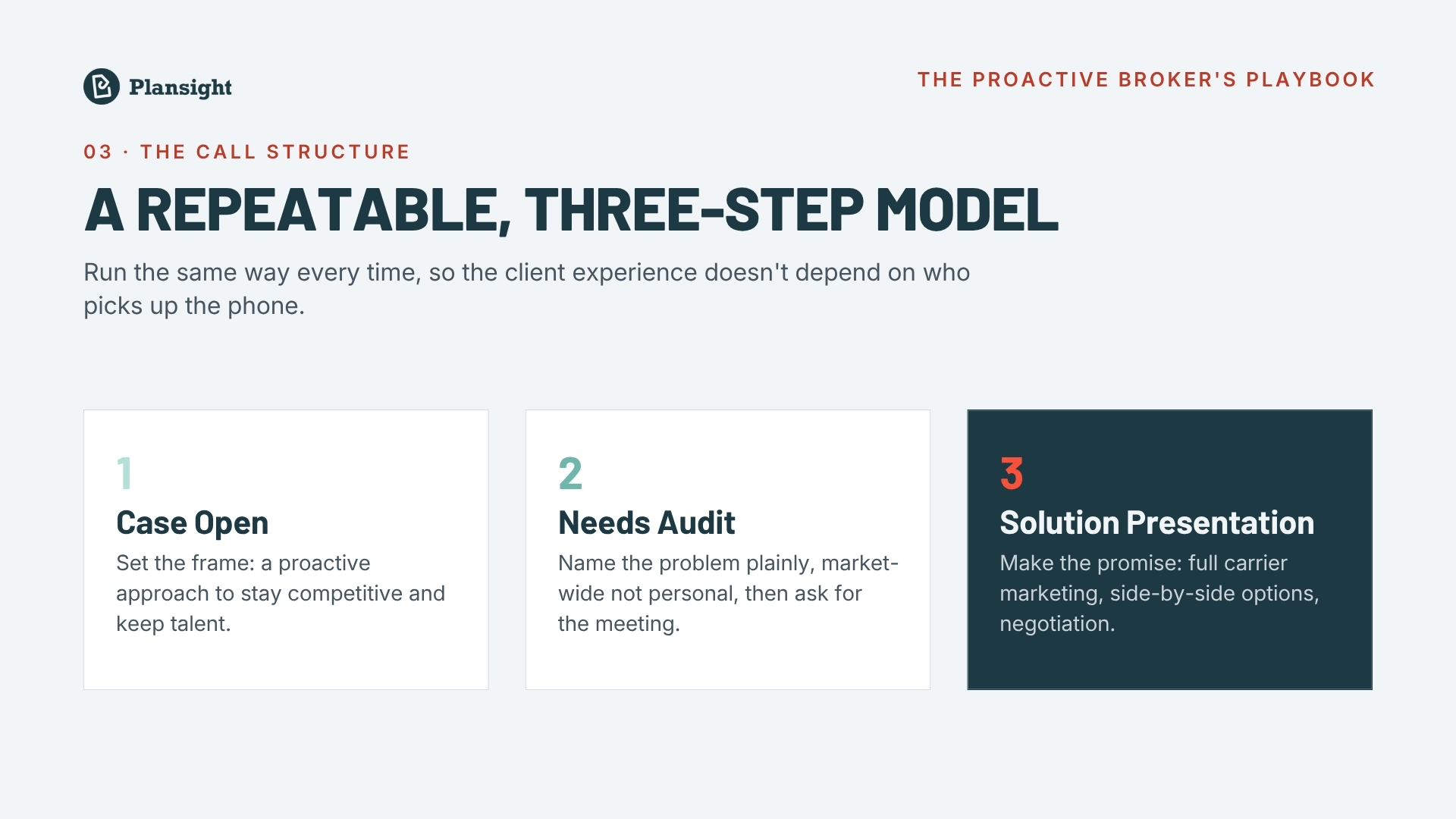
Steve laid out what actually sits behind that solution-presentation promise: market every eligible carrier and funding strategy, not just the two you always go to. Chase proposals that come back on the carrier's schedule, in a PDF, a spreadsheet, sometimes a screenshot pasted into a spreadsheet. Retype each one into a client-facing side-by-side so the comparison is apples-to-apples. Negotiate. Build the deck. Book the meeting. Walk the client through it.
That's one client. Multiplied across a book of sixty or seventy accounts, it stops being a time-management problem and becomes a math problem no single team can solve by hand.
Plansight can do that all for you.
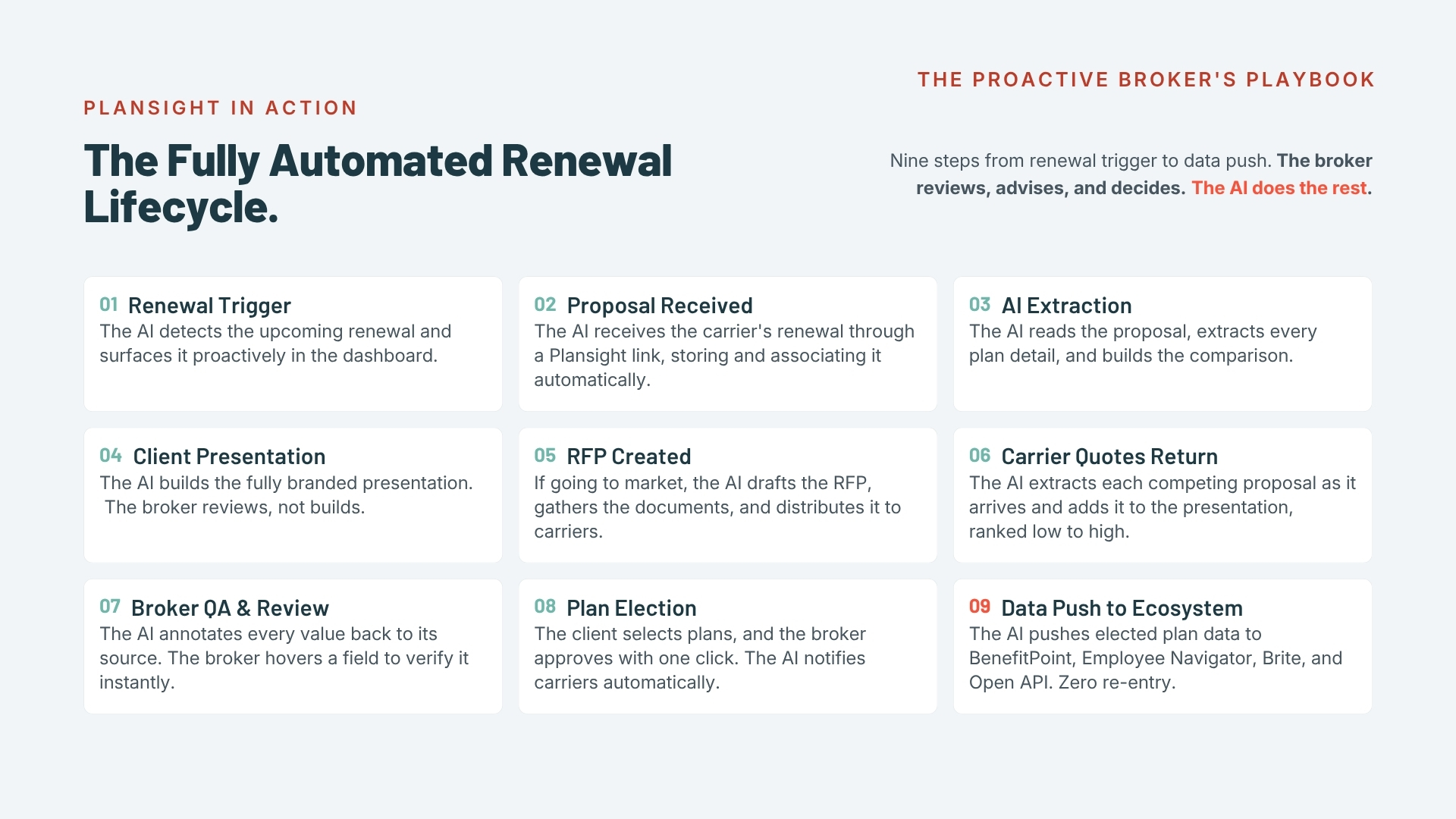
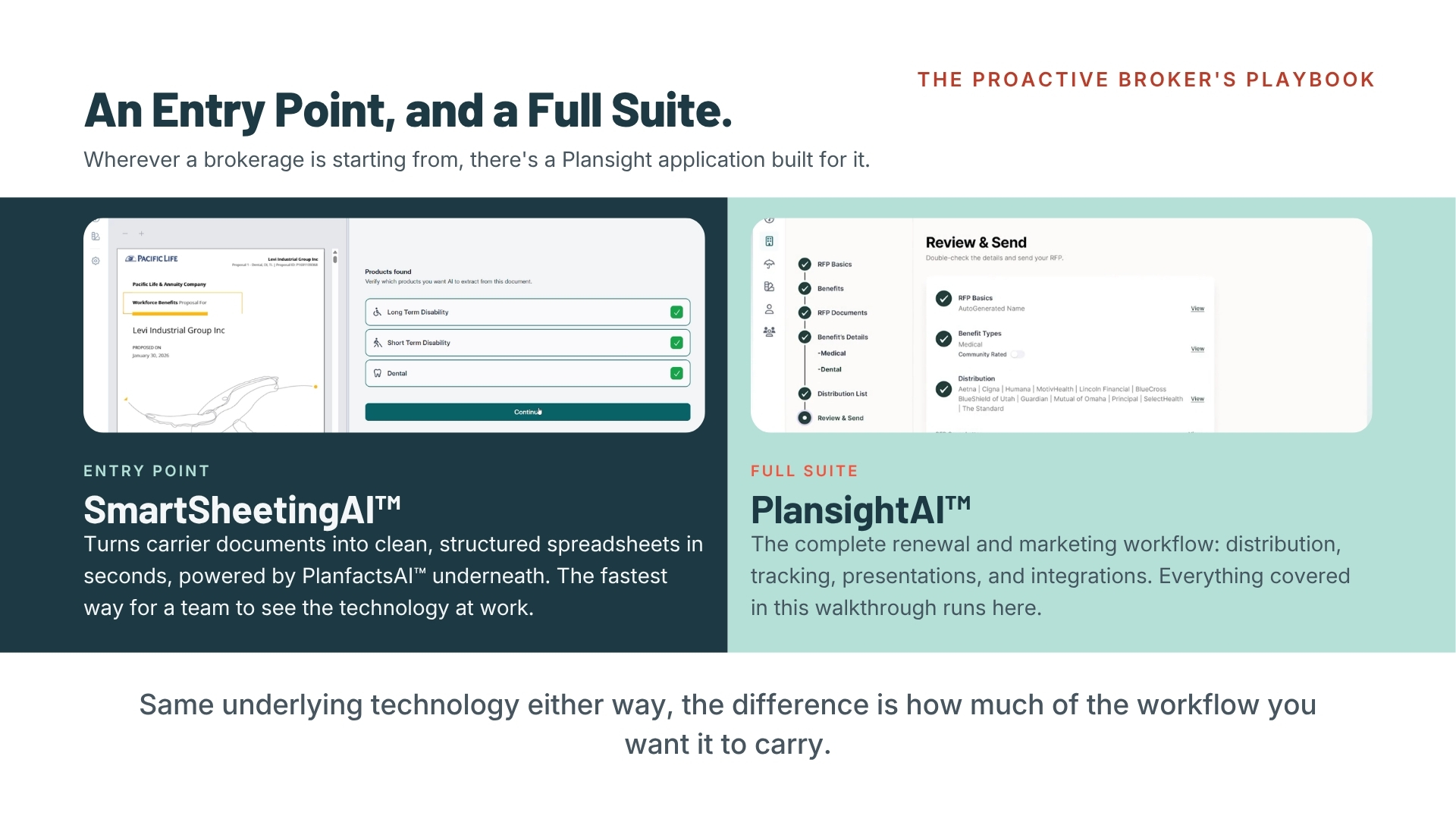
PlansightAI™'s benefits renewal and marketing workflow automates most of that sequence end-to-end. The AI gets triggered when a renewal is approaching, receives and extracts carrier proposals as they land, drafts the RFP, manages carrier distribution, and builds the client presentation as quotes come in and are ranked. Once a client's elections are made, it pushes them into the benefits administration system and the agency management systems and automatically sets next year's benchmark.
That leaves two things for the broker's team: reviewing the output, and sitting down with the client to advise and decide. Weston summed it up on the call: "You review, you advise, you decide. PlansightAI™ runs the nine steps in between."
For a lighter need, SmartSheetingAI™ handles just the extraction step on its own: drop in a policy, certificate, or carrier quote, and it returns a formatted spreadsheet, typically in under two minutes.

Nine to ten percent will reach your clients this fall. That part isn't up to any broker, or to Plansight. The only variable is which meeting a client has when they hear it: the one where they read it in a letter, or the one where a broker already called with a plan in motion.
Running that second version of the meeting for an entire book, not just the top ten accounts, is a workload problem before it's anything else. Solve the workload, and the call itself only takes eight to twelve minutes.
If you haven’t seen Plansight in action and you want to, book a discovery call with us.
At the end of the day, Plansight is more than just an application. It is a partner built with brokerages and their benefits teams in mind. Plansight is the only AI application that manages your benefits renewal and marketing workflow. It brings transparency, consistency, and time savings to every group renewal.
From SmartSheetingAI™ to RFP automation to side-by-side comparisons to the intelligence of PlansightAI™, everything we create is designed to lighten the load, reduce risk, and elevate your client relationships. Your team is your greatest asset, and Plansight is here to make sure they have the tools, insights, and support to shine.
Plansight works alongside leading General Agencies to help brokers move faster, stay compliant, and deliver a better client experience. You can explore our trusted GA partners here.
For brokers, Plansight transforms a manual, time-consuming RFP workflow into one that is faster, more efficient, and more profitable, without sacrificing accuracy or control.